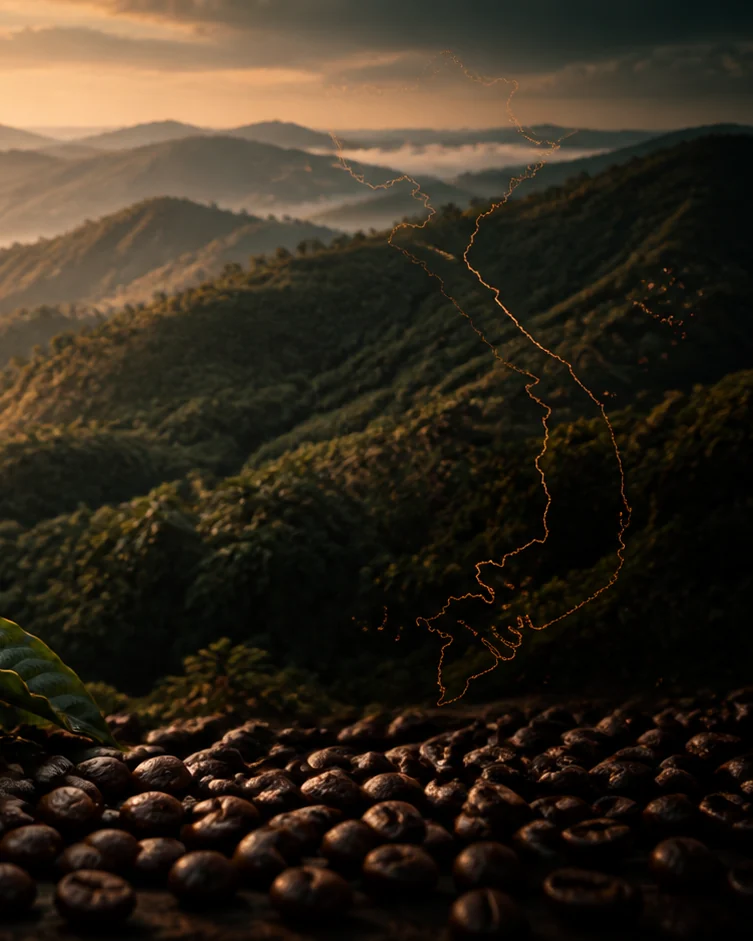
For years, much of specialty coffee spoke about Robusta only in comparison with Arabica. Arabica was described through place, variety, processing, and flavor. Robusta was often reduced to a few blunt words: strong, bitter, cheap.
That framing left out the most interesting part.
Robusta is not simply a louder version of another coffee. It is Coffea canephora, a coffee species with its own structure, growing behavior, sensory range, and cultural history. It can bring substantial body, texture, and intensity to the cup. Those qualities make it especially at home in espresso, milk drinks, and the slow concentration of a Vietnamese phin.
The problem was never that Robusta had a clear personality. The problem was that the coffee industry often treated that personality as a flaw.
Vietnam changes the frame
In Vietnam, strong coffee is not a novelty campaign. It is part of everyday life. Coffee creates time: a few minutes while the phin drips, a seat on a small stool, a conversation that stretches beyond the empty glass.
That culture does not fit neatly into the idea that one species, one roast style, or one brewing method defines quality. Vietnamese coffee moves between tradition and experimentation—between dark, concentrated cups and a growing contemporary specialty scene willing to ask what the country’s coffees can become.
That makes Vietnam more than a place to source from. It is the right context for a wider conversation about Robusta.
Strength and quality are not opposites
A coffee can be bold without being careless. It can have weight without losing balance. It can stand up to milk or ice and still be worth drinking black.
The question is not whether Robusta should behave like Arabica. The better question is whether the coffee has been grown, processed, roasted, and brewed in a way that lets its own qualities make sense.
That shift matters. Once Robusta is judged on its own terms, the conversation becomes more useful. Instead of asking why it is not delicate enough, we can ask whether the body feels structured, whether the finish feels clean, whether the intensity has dimension, and whether the cup invites another sip.
Better storytelling requires better proof
Premium language is easy to write. Product truth takes more work.
Specific origin, producer, lot, harvest, process, score, and impact claims should be supported before they are placed on a product page. That is especially important in a category already burdened by shorthand. Robusta does not need another exaggerated promise. It needs better information.
At LVL, that means separating category education from product truth. Our current Highland Harmony release is a 500 g whole-bean blend of Robusta and Arabica from Buon Ma Thuot, Vietnam. Deeper batch information will be added only as it is confirmed.
A category worth meeting again
LVL is interested in what happens when Robusta is treated seriously: when its role in a coffee is described clearly, when origin becomes information, and when Vietnamese coffee is allowed to lead the conversation instead of appearing at its edge.
Robusta deserves its own frame. That conversation can stand on its own while each LVL product is described by its verified composition.